
Sample Lesson from The Book of Exodus 2026-2027
Current Study Lesson 1

THE BOOK OF EXODUS
Lesson 1 – Study Questions
Commentary Introduction and Exodus 1:1-22

Review: From your experience at the Cornerstone meeting last week, share something that helped build your faith.
NOTE: Welcome to our study of The Book of Exodus. Exodus “surely ranks high on the list of most exciting pieces of literature ever written…Dramatic as it is, however, Exodus is much more than entertainment. Israel’s deliverance from Egypt holds an essential place in the history not only of Jews but of Christians as well. God’s promise to rescue humankind from the forces of sin and alienation, first recorded in the book of Genesis, unfolds in the story of the Exodus. This story of salvation is one story, and the faith of Jews and Christians alike is rooted in these saving actions of God. EXODUS, God to the Rescue, Jeanne Kun
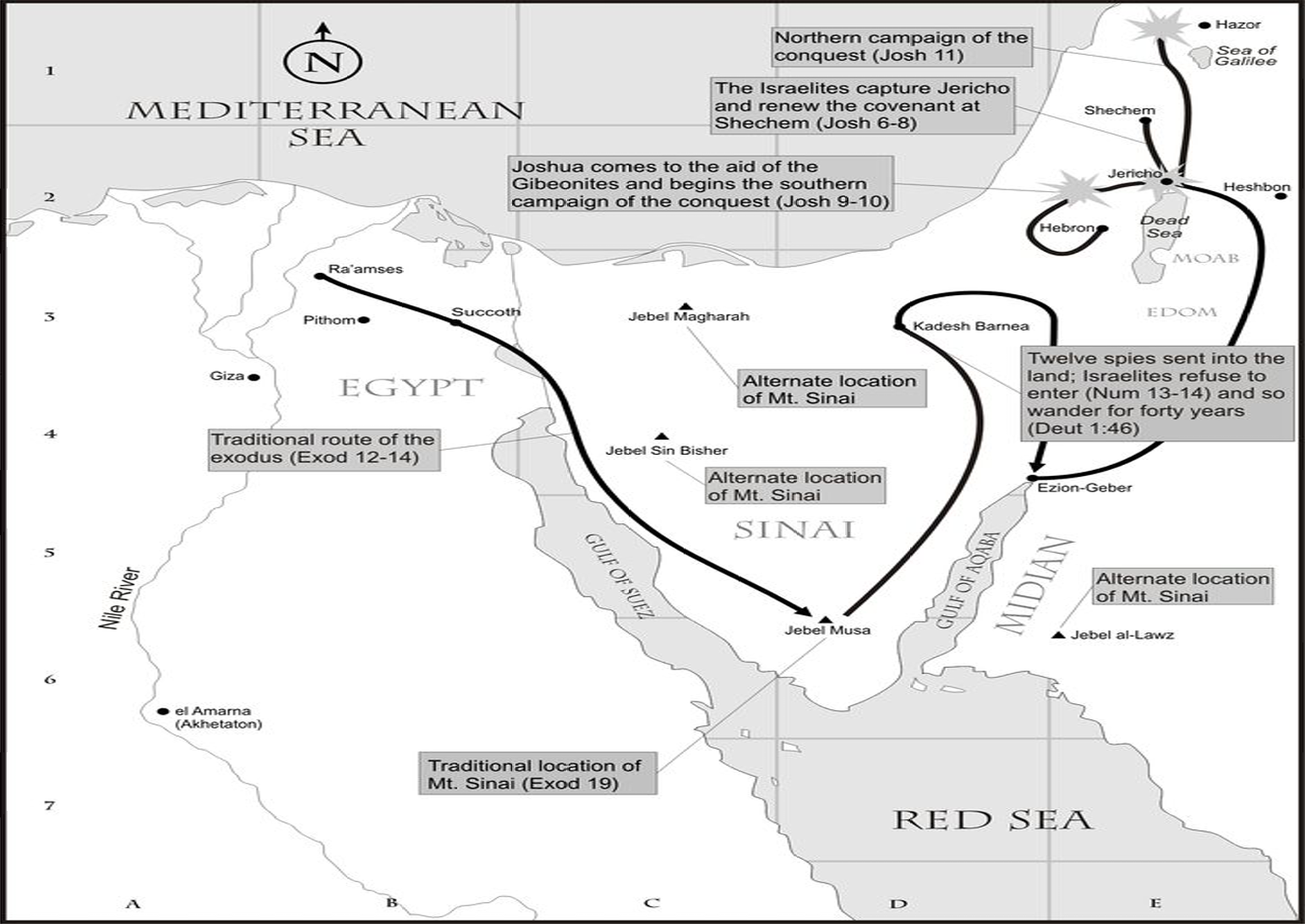
As we follow this exciting journey we may ask “is the Exodus about an historical event?” Most scholars (Catholic and others) believe it is a combination of historical and theological events. “It is probable that the Book of Exodus rests on the firm foundation of history.” Ignatius Catholic Study Bible
Here is a map which may be helpful as you move through your study of the Book of Exodus.
DAY ONE
Read the Foreword to Exodus, Fr. Paul J. Niemann, pages 3-9
1. In his Introduction to Exodus, Fr. Niemann states that all the books of the Bible are believed to be inspired by God. What does he say is the simplest explanation of the term inspiration?
2. The Introduction lists some of the many ways to read the Bible (for example, searching for information, reading for historical detail, for Church teaching, for advice, for prayer, and so on, or any combination). Consider if (or how) your reading of the Bible has changed over the years. To what would you attribute any changes?
THINK: For what reasons are there times when you specifically turn to the Bible?
3. Fr. Niemann also says that “biblical stories are true because they are God’s word for us…whether the event occurred exactly as it was described is irrelevant…The living word of God is an ocean which cannot be bottled up in our tiny categories of fact and science.” How will this advice help you to approach reading Exodus with its many amazing stories?
4. Exodus is the second book of the Torah, a Hebrew word meaning instruction or law. The Torah is also called the Pentateuch, a Greek word meaning five books. Tradition holds that the first five books of the Bible, also known as the five books of Moses, were written by Moses. Share one or two comments from Fr. Niemann regarding the authorship of Exodus.
5. CONNECTION: Fr. Niemann tells us that “Exodus gives us an insight which guides our life both as individuals and as communities.” Stories from the Old Testament, particularly from books such as Genesis and Exodus, often become familiar to us in childhood, and can be teaching points in our early faith journeys. If there is an Exodus (or Genesis) Bible story that you particularly remember, briefly share what it is and why it is meaningful to you.
Read and record 2 Timothy 3:16 and let these thoughts lead you into prayer.
DAY TWO
Read Exodus 1:1-14
6. The Book of Exodus is a continuation of Genesis. Exodus’ first words are “These are the names.” These same words occur in Genesis 46:8, emphasizing the continuity of God’s love for Jacob’s descendants. Many of us have become interested in our ancestry or even bear the name of an ancestor. Perhaps you have an ancestor whose name has continued to be remembered in your family. Why would you think this is important?
7. The Genesis story of Joseph and his many-colored coat is a familiar one. Joseph’s father, Jacob and his 11 brothers and households went to Egypt to avoid famine in Canaan. Before they left Canaan, Jacob received an assurance from God. Read Genesis 46:3-4 and record the phrase that would have assured Jacob/Israel that his descendants would not have to stay in Egypt forever.
NOTE: “The Israelites became fruitful and multiplied and became exceedingly strong” (verse 7). The words fruitful and multiplied echo “the divine blessing bestowed upon humanity at creation (Gen 1:28) and after the flood (Gen 9:1) as well as suggesting fulfillment of the promises to the
ancestors Abraham, Isaac, and Jacob.” Notes, NABRE
8. The new Egyptian king, seeing the population growth, feared that the Israelites might join with Egypt’s enemies against them. From verses 11-12, briefly summarize Pharaoh’s solution to this problem and why it backfired.
9. The Israelites’ oppression under their ruthless taskmasters in Egypt became a symbol of many forms of bondage and injustice suffered by human beings. What parallels can be drawn between the oppression of the Israelites and modern instances of oppression? (see verses 13-14)
10. CONNECTION: Pharaoh’s effort to control the Israelites was driven by fear. Fear can lead us to mistrust, doubt and faulty decision making. Bishop Robert Barron suggests, “invite your fears in to tea.” Share a time when, with the help of the Lord, you faced your fears and found them not as overwhelming as you thought.
Read Psalm 33:20 and write a prayer today expressing your hope in the Lord that sustains you in times of trial.
DAY THREE
Read Exodus 1:15-17
11. The Israelites were made to work at forced labor, at mortar and brick making and all kinds of field work. Read Romans 5:3-5 and share some thoughts on how we can learn from suffering and hardships.
12. God established a covenant with Abraham, promising to make his descendants a great nation, but he also spoke of enslavement as well as their escape from a foreign land. Read and complete what the Lord said to Abram in Genesis 15:13-14:
Then the LORD said to Abram, “Know for certain that your descendants
where they shall be enslaved and oppressed
But I will bring judgment on the nation they must serve,
13. While the name of the Pharaoh is never mentioned, the point is still clear: the rulers of Egypt cruelly oppressed the Hebrews. Refer to the Commentary, page 15, for Fr. Niemann’s explanation of the word pharaoh and its usage in the Bible.
NOTE: The midwives’ names are clearly stated in this chapter while the king’s name is never mentioned. Our commentary states that, “Scholars generally agree that Seti I is Pharaoh at the time of Moses’ birth. Seti’s son, Rameses II (ruled 1290-1224 BC), is believed to be the Pharaoh at the time of the actual Exodus.”
14. Because the midwives feared God, they did not do as the king of Egypt ordered them but let the boys live. Select one of the following passages to aid in your understanding of fear of God.
Deuteronomy 8:5-6
Psalm 25:12-14
Proverbs 1:7
15. CONNECTION: The midwives knew that Pharaoh’s command was immoral and followed what was right in God’s eyes. Like Shiphrah and Puah, we, too, must continuously discern right choices when faced with competing spiritual and secular values. In what ways do you see today’s passage from so many centuries ago applying to your life today?
Read and record Acts 5:29, and pray today to discern God’s will in your life every day.
DAY FOUR
Read Exodus: 1:18-19
16. The king summoned the midwives, Shiphrah and Puah, and asked them why they had not done as he asked. How did they respond?
17. Like the midwives in this chapter, there are many examples in scripture of good people standing up for what they think is right despite uncomfortable or risky situations. Choose one of the following passages and briefly summarize the choice between good and evil.
Daniel 3:15-18
Ephesians 6:18-20
18. Describe a time when you or someone you know have also stood up for what you believe is right despite the circumstances. What was the outcome?
19. Imagine the intensity of the confrontation between the midwives and the king. Anytime we have a confrontation with another person, no matter how peaceful it is intended, it can easily escalate. Read James 3:13-18 and record verse 17 which may assist us in how to deal with confrontation.
20. CONNECTION: Like the midwives, we often face conflicting demands. In our lives, those choices are more often demands on our time. It can be very difficult to prioritize those demands to meet the needs of a job, home, church, and of course, our faith. Sometimes we resort to trying to meet all of them rather than selecting one. What is your approach to sorting out what is most important?
Read the following prayer from a St. Padre Pio novena and pray that God will guide and aid you in times of discernment.
Dear Lord:
Help me to clearly see Your will in my life
and give me the wisdom to make decisions that are pleasing to You.
May I have the courage to follow the path
You have laid before me, even when it is unfamiliar or uncomfortable.
Teach me to separate the noise of the world from
Your voice, and to have a heart that seeks You first.
In Jesus’ name.
Amen
DAY FIVE
Read Exodus 1:20-22
21. As chapter one ends, the midwives have saved the Israelite male children. How is the theme of “being fruitful and multiplying” once again recorded in verse 20?
22. According to verse 21, what did God do for the midwives because they feared him?
23. After his plan failed to have the midwives kill the Israelite male infants, the Pharaoh became desperate, and he planned to exterminate them by having the boys thrown into the Nile. Per Fr. Niemann’s Commentary (p. 17), what could be a reason that the Pharaoh allowed the Israelite girls to live?
24. In verses 15-21 the words midwife or midwives are repeated eight times. There could be many reasons for this, one of which is simply that their act of faith shows that sometimes God works through ordinary people. Is there a task to which you felt God was calling you and for which you originally felt inadequate or unqualified? What was the outcome?
THINK: The Bible is full of stories of seemingly ordinary people such as Moses (a shepherd), David (a young shepherd), Ruth (a widow), and Mary (a young woman). How did their being ordinary allow God to be more glorified in their lives?
25. CONNECTION: Even though the presence of God is only mentioned in rewarding the midwives, we can look back and see signs that God’s ongoing work of creation and blessing were at work for his people, even in a foreign land. It is also often true that we do not notice God’s hand at work in our lives until after the fact. Can you share a story of God at work in your life, even though you might not have noticed right away?
Read Psalm 139:1-6 and record a few words that remind you of God’s intimate presence in your life.
FINAL THOUGHT for the WEEK
We cannot say for sure if the tale the midwives told Pharaoh was a complete lie; it could have been a half-truth. Perhaps they really did arrive too late. More importantly, if their story was a lie to save the children, was it still a sin?
“The moral question of lying is one of the most interesting and most difficult to resolve perfectly and precisely. It has occupied the attention of moral theologians since the Patristic Age.” (Catholic Culture, Dr. Jeff Mirus) Fr. Thomas Joseph White, OP also reminds us that not all acts which are morally imperfect are equal in “moral gravity”. (Brazos Theological Commentary) What are your thoughts on whether there is ever a time when lying is not a sin?
Read Lesson 1 in our Commentary, The Book of Exodus by Rev. Paul J. Niemann, D.Min. The Cornerstone Catholic Scripture Study acknowledges that scripture quotations in this study are from the New American Bible Revised Edition (NABRE) © 2010, 1991, 1970 Confraternity of Christian Doctrine, Inc., Washington, DC All Rights Reserved. Used with permission.
Copyright 2026 The Cornerstone Catholic Scripture Study
thecornerstonescripturestudy.org